

GIBBON, Neb. (CN) - Before dawn on a recent Friday, thousands of sandhill cranes stood on long spindly legs in the shallow waters of the Platte River. Squawking and chortling, the flock hit unique notes that only these cranes can sound.
As the sun rose, the flock seemed to stretch down the river for at least a quarter of a mile.
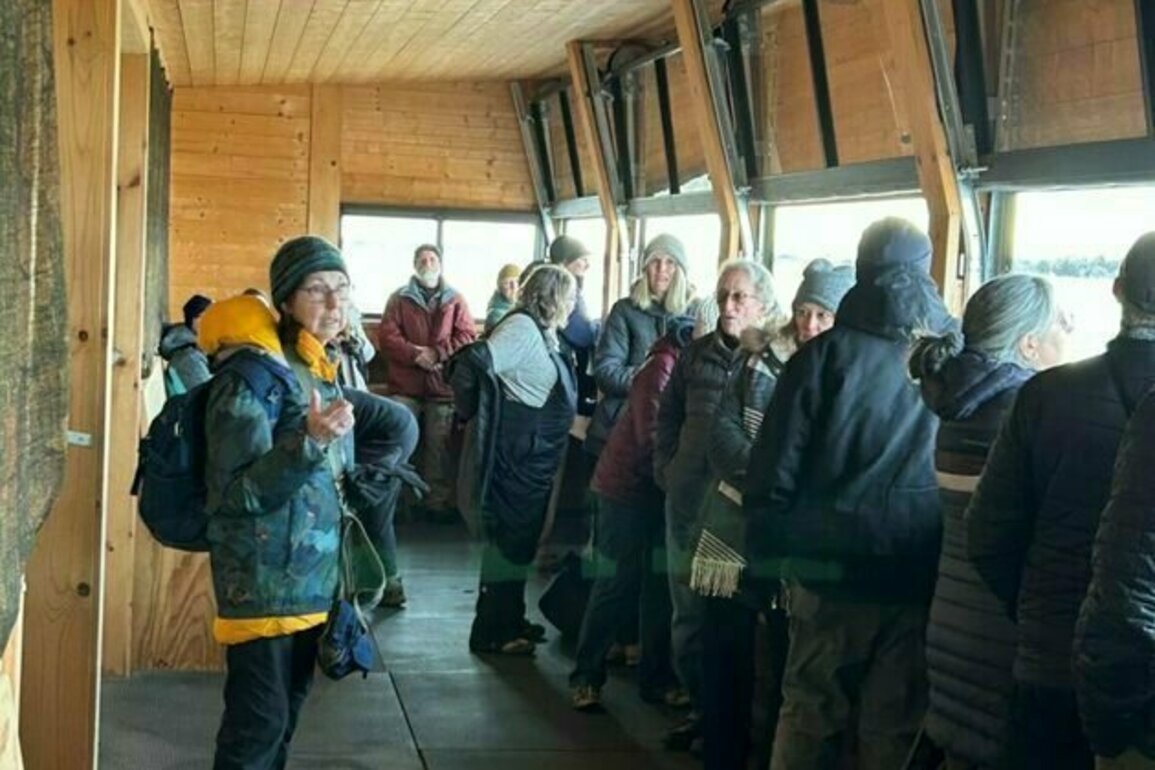
A short distance to the south, around a dozen tourists waited with cameras ready in a bird blind at Rowe Sanctuary.
Suddenly, a bald eagle swooped down, landing on a sandbar and spooking the cranes. The flock lifted into the sky, spiraling in the air as they moved east.
Visiting from Winston-Salem, North Carolina, tourist Leesa Goodson aimed her camera. She had a special 150/400 lens made for bird photography.
"I not only got a picture of them going up, I also got a shot of two bald eagles," Goodson beamed later in an interview with Courthouse News. "Some people were disappointed that they lifted so early, but it was so fantastic to watch."
Every year in March and April, Nebraska plays host to one of the world's most remarkable migrations, as roughly one million sandhill cranes flock here from Texas, New Mexico and Mexico on their way north to Canada, Alaska and Siberia.
Around 80% of them stay within just a roughly 75-mile span of central Nebraska's Platte River Valley, according to the Nature Conservancy. The squawking visitors stay for weeks, bringing millions of tourist dollars to this region and helping make the Cornhusker State "America's Serengeti," as John Van Gundy, a volunteer here, put it.
As the sandhill cranes arrive, so too do the bird lovers. At another blind downriver was Lauren Bailey.
A cousin of Goodson, Bailey splits her time between Nevada and Nebraska. She'd agreed to meet her in the Cornhusker State for a crane-watching vacation at Rowe Sanctuary.
The flock of cranes soon passed by as they fled from the bald eagle. "You just see a swarm of birds coming at you, and it just [keeps] coming," Bailey said. "Honestly, for the first time seeing it, it was really dramatic. I think both of us came away with a real appreciation for this."
With widths in the hundreds of feet and depths of only around 8 inches in many places, the Platte River is a perfect pit stop for the sandhill crane, which has an affinity for shallow water.
Shallow water is a key characteristic of the Platte River - and indeed, maps of sandhill crane migration routes resemble an hourglass, as cranes converge on this region before spreading out again as they continue north.
As the sun sets, flocks of the mighty birds camp out on the Platte. They sleep standing up on and between sandbars in the river.
The river works like a home-security system, its waters giving off an audible warning if a predator approaches. "The minute a coyote steps into that river, you'll hear the alarm call [and] they're gone," said Van Gundy, the Rowe Sanctuary volunteer.
Crane numbers in Nebraska peak around mid-to-late March. Each crane spends about 29 days there, increasing their body weight by around 20% during their stay.
They feed in nearby fields, storing up nutrition for the long flight north and eating calcium that they'll later use to produce strong eggshells. They flip over cowpies to pick at grubs, just as they once did with buffalo dung.
"They eat the waste corn, which is good," volunteer Diane Anderson of Shoreview, Minnesota, said, explaining how the birds benefit agriculture in the area. All that feasting "frees up the ground for the new seeds."
Mostly slate gray except for red crowns, adult sandhill cranes stand around 3 to 4 feet tall and have wingspans of around 6 to 7 feet. They have families and mate for life. These charismatic birds let off chortling songs, often described as bugling or trumpeting. Their tracheas are long and coiled, reverberating against their sternums as they sing and allowing their cries to be carried for great distances.
All of this creates quite a sight for tourists, who follow the cranes to the Platte River Valley each spring. Many flock to the Rowe Sanctuary near Gibbon or the Crane Trust Nature & Visitor Center near Alda, both of which offer guided blind tours at sunrise and sunset.
So far this year, Rowe Sanctuary has welcomed visitors from every state and 33 countries. This annual tourist migration provides an economic boost to cities along the bird-migration path, said Brad Mellema, a tourism official for the city of Grand Island.
A 2017 study found that 46,500 crane tourists traveled to central Nebraska for the migration that year. Rowe Sanctuary and the Crane Trust had an economic impact of $3.72 million, creating the equivalent of 46 full-time jobs, while crane tourism in general brought in $10.58 million and supported 136 jobs.
"It is part of the identity, I think, of Nebraska," Mellema said of these twin migrations. In cities like Grand Island and Kearney, "cranes put a lot of heads in beds. Other communities don't have that shot in the arm."
The night before their early-morning crane viewing, Goodson and Bailey joined an evening blind tour. Volunteers John Van Gundy and Diane Anderson led the group of around 28 people, some of whom had come from as far away as California and Rhode Island.
Goodson and Bailey had been planning a trip to see the sandhill cranes for years. A birder, Goodson and was inspired by a Jane Goodall film about the migration.
"I really want the experience," she said. "There is nothing else like it in North America I can think of."
From the Rowe Sanctuary visitor center, the group walked for around a quarter of a mile along a path through the prairie grass.
When they got to the blind by the river, the excited birders didn't know what to expect. Would the cranes land in front of the blind, giving everyone a front-row view? Would they land out of sight somewhere else on the river?
It was impossible to predict, Van Gundy told the group. Every night is different.
"It's arbitrary," he explained. "There is no pattern. None."
As sunset neared, flocks of trumpeting cranes seemed to be getting closer to the blind - though they were still several hundred feet away.
The tourists fell silent as more cranes flew by. The flocks grew bigger, forming horseshoes and V shapes as they let out their trumpeting calls.
"Oh man, it's like mosquitoes in Minnesota," one bearded tourist exclaimed about the throng of cranes. He moved to take a photo, but Van Gundy stopped him. Even without flash, the glow of a cellphone could startle the cranes and affect their landing, he explained later.
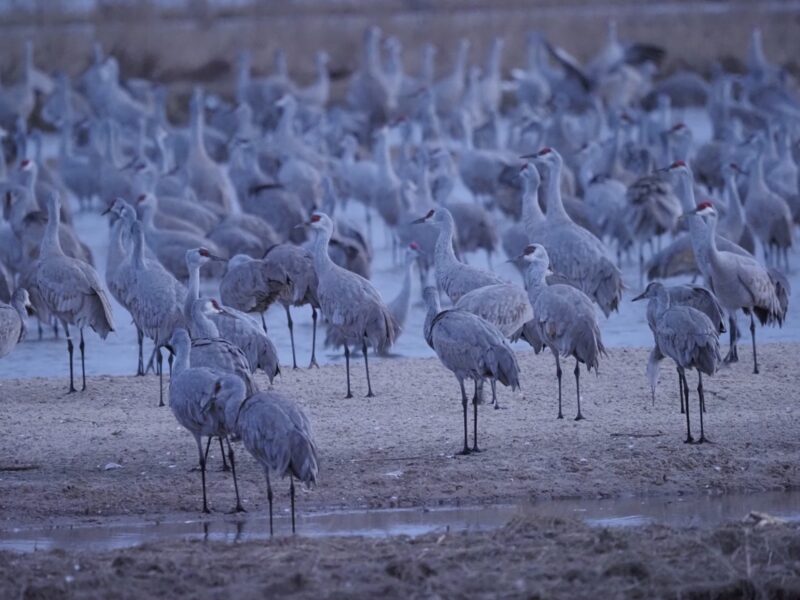
As the light grew dimmer and the cranes harder to see, it seemed for a moment that this unlucky group of tourists would not get their close-up shots. Then cranes began landing on a sandbar around 300 feet in front of the blind, shadowy, long-legged figures poking around in the sand and water.
"It's just so dark," one visitor said.
Then more and more landed, hundreds of them, their calls echoing down the river. As even more arrived, they formed an undulating black mass that obscured the view of the river. The sight was both electrifying and relaxing in a way that's hard to explain.
The cranes waded towards the blind for a moment, covering the river as their cries filled the air. It was nighttime now, and though the birds were so close, they were easier to hear than to see.
Then it was time to leave. The line of visitors stumbled back through the dark to the visitor's center, using red-light flashlights so as not to startle the birds.
"It was really nice when they landed," said Cecilia Longenbaker of Burrillville, Rhode Island, reflecting on the experience later. "It was dark, but it was really cool to see them walking toward you."
She and her husband Mike drove around the next day, spotting cranes in the fields and visiting public viewing areas. But it wasn't quite like in the blind: Out in the open, the birds don't like to get too close to humans.
Mike had also enjoyed the tour. "The blind gives you a better experience, because the birds get closer to you," he said. The retired couple, who spent several months each year in a motorhome, had been complaining about the drive across Nebraska when someone suggested they stop to see the cranes.
Poor light may have made the evening blind tour may have been somewhat underwhelming, but Goodson couldn't believe her luck the next morning when cranes came to rest right in front of her mind.
"No one can predict that behavior," she said.
Overall, it had been a fun trip for the cousins. They spent the rest of the day driving around the Platte River Valley, stopping periodically to watch cranes feed in unplanted fields.
"We saw them moving from one field to the rest," Bailey said. "We saw them floating down and landing." So abundant were the cranes that it took the pair hours to get back to their hotel. In every field they passed, there the majestic birds seemed to be.
Source: Courthouse News Service